Address
Nanzhai village, Liushi Town, yueqingCity, zhejiang Province, china
Tel
+86-13375775325
Views: 0 Author: Site Editor Publish Time: 2026-09-08 Origin: Site

Grid failures often begin with a deceptively simple mistake. Incorrect insulator selection is a primary culprit in many structural collapses. Mixing up suspension and tension components during the procurement or design phase causes costly construction delays. Worse, it poses severe safety risks to the entire transmission network. In this comprehensive guide, we strip away the marketing fluff to focus on core engineering principles. You will learn the exact mechanical differences between these critical grid components. We will also explore modern composite material upgrades currently reshaping global power infrastructures.
Primary Function: Suspension insulators support the vertical downward weight of conductors on straight transmission line sections. Tension insulators handle the intense horizontal mechanical pull at dead-ends, corners, or sharp curves.
Installation Orientation: Suspension strings hang vertically toward the ground. Tension strings are installed horizontally or at a specific angle in line with the conductor.
Material Superiority: The power industry is rapidly shifting toward polymer materials. Composite units offer superior environmental pollution resistance and are significantly lighter than traditional porcelain equivalents.
Interchangeability: Although they appear visually similar to an untrained eye, they are engineered for entirely different mechanical load vectors. They cannot be safely swapped without rigorous load calculations.
A suspension insulator is a foundational component in overhead power transmission networks. Line crews install these units to hang directly from the cross-arm of a transmission tower. Their primary function is elegantly simple yet critical. They support the high-voltage conductor at its lowest point while safely isolating the live wire from the grounded metal structure.
From a strict engineering perspective, this component bears primarily vertical loads. This mechanical burden consists of the downward gravitational weight of the conductor itself. Dynamic environmental stresses heavily compound this weight. Imagine a transmission line during a severe winter storm. Radial ice accumulation drastically increases the vertical drag on the string. While its main job is vertical support, the unit must also possess enough flexibility to swing. This pendulum motion helps withstand minor transverse loads caused by crosswinds pushing against the suspended cable.
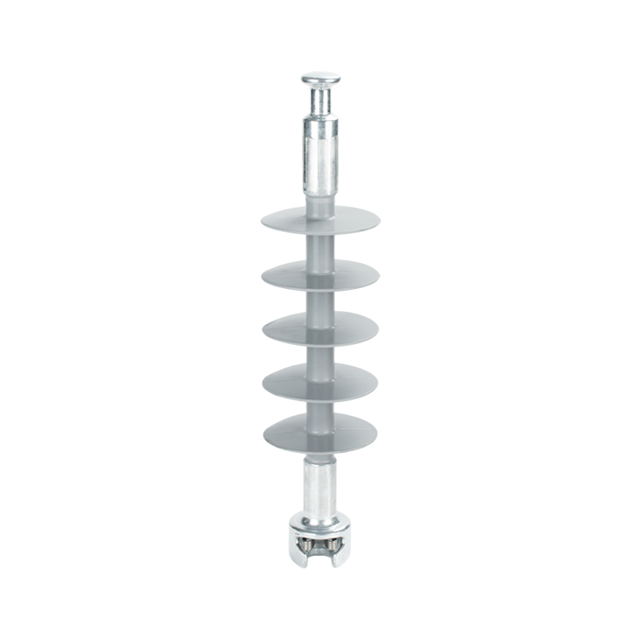
Historically, utility grids relied heavily on massive strings of porcelain discs. Today, modern grid infrastructure demands a massive material evolution. Utilizing a central core made of high-strength fiberglass to handle the mechanical load, surrounded by a molded silicone rubber housing, advanced designs eliminate the brittle nature of legacy ceramics. For example, a standard 15kV Composite Suspension Insulator typically features a Specified Mechanical Load of 70kN and a creepage distance exceeding 400mm. This specific configuration provides medium-voltage distribution networks with an ideal balance of lightweight handling and exceptional durability against environmental degradation.
While suspension models carry vertical weight, a tension insulator serves a fundamentally different mechanical purpose. Field engineers frequently refer to these as strain insulators. Heavy-duty construction crews deploy these components strategically at specific high-stress points in a network. You will find them where a line terminates at dead-ends, where the route changes direction at a sharp angle, or across massive physical spans like wide rivers and deep mountain valleys.
The core function here is withstanding immense horizontal tension. Strung tightly between two towers to maintain strict ground clearance regulations, a heavy conductive cable generates a massive pulling force. The tension unit is installed directly in-line with the conductor. It acts as the robust anchor point holding this longitudinal pull. Simultaneously, it prevents electrical current from traveling down into the steel anchor tower.
Because the mechanical load is highly concentrated and horizontal, these units require extraordinarily high tensile strength. Decades past required massive porcelain assemblies to achieve this. Today, leveraging aerospace-grade fiberglass cores changes the game entirely. An 11kV Composite Tension Insulator can provide tensile strength matching or exceeding traditional ceramics, often rated at 70kN or even 120kN for heavy-duty applications. The internal pultruded fiberglass rod is specifically manufactured to handle extreme longitudinal pulling forces without snapping. This secures the mechanical anchor point while significantly reducing the dead-weight burden on the tower structure.
To assist procurement officers and line designers in making accurate specifications, we must clearly delineate the fundamental differences. While both utilize similar dielectric housing materials, their internal mechanical engineering sets them miles apart.
Feature | Suspension Insulator | Tension Strain Insulator |
|---|---|---|
Primary Mechanical Load | Vertical downward weight of conductor | Horizontal tensile pulling force of conductor |
Installation Orientation | Vertical hanging straight down | Horizontal or Angled in-line with conductor |
Tower Type Application | Tangent towers, straight-line suspension towers | Anchor towers, dead-end towers, angle towers |
String Configuration | Often single strings; lengthened for higher voltages | Often uses multiple parallel strings for extreme loads |
Flexibility | Swings freely with wind to relieve stress | Rigidly fixed to maintain conductor tension |
The most critical distinction lies in the force vectors they manage. A suspension unit acts much like a pendulum. It supports the vertical mass of the cable. If a conductor snaps in the middle of a span, the suspension hardware simply drops vertically. Conversely, a tension unit acts like a taut rope in a high-stakes tug-of-war. It constantly fights the longitudinal pull of the tightened conductor. This requires specialized end-fittings, such as clevis tongues or socket eyes, to grip the wire securely.
Recent shifts in the global energy sector highlight a growing urgency for grid modernization. Extreme weather events, ranging from unprecedented ice storms to hurricane-force winds, are becoming more frequent. Under these dynamic mechanical stresses, legacy porcelain infrastructure is failing at alarming rates. Structural fractures in ceramic discs lead to cascading network outages.
Furthermore, the rapid integration of renewable energy sources requires expanding transmission lines into remote, rugged terrains. Industry analysts note a definitive trend across global utility boards. Grid operators are aggressively phasing out ceramics. They are replacing them with any high-performance Composite Insulator that can endure violent mechanical shocks. This transition is driven by the urgent need for hardware that resists heavy industrial or coastal pollution without frequent washing. Upgrading to polymers significantly lowers the structural load on aging transmission towers, drastically reducing Operational Expenditure and extending the lifecycle of the entire grid.
Selecting the correct hardware is not merely a matter of preference. It is a strict engineering requirement dictated by the specific location, mechanical stress, and environmental conditions of the line. Understanding these precise scenarios prevents catastrophic mechanical failures.
For the vast majority of any overhead route, the line travels in a relatively straight path across open terrain. Tangent towers support these uninterrupted sections. Here, the primary mechanical force is the downward vertical weight of the cables. Suspension models are the absolute default choice. Hanging vertically from the cross-arm, they perfectly support downward loads while maintaining the necessary ground clearance for high-voltage cables.
Transmission lines must eventually terminate at a substation to step down the voltage. At these termination points, the entire horizontal pulling force of the line abruptly stops. Substation structures require heavy-duty anchoring. Utilizing a Polymer Tension Insulator in these junctions provides the necessary mechanical grip. It also offers superior resistance to the localized pollution often found near urban substations. Similarly, when a route must cross a wide physical obstacle like a highway, the tight stringing creates an immense horizontal pulling force. Tension strings are mandatory here to absorb the extreme tensile stress.
Selecting the correct hardware requires a careful analysis of both electrical and mechanical parameters. Project managers must ensure specified units meet international standards like IEC or ANSI. Instead of relying on generic descriptions, buyers must evaluate direct performance metrics.
The most fundamental specification is the electrical voltage rating. The hardware must withstand the normal operating voltage alongside temporary overvoltages caused by switching surges. For standard distribution networks, buyers commonly specify 11kV, 15kV, or 33kV ratings. Select a unit that precisely matches or slightly exceeds the system voltage. This provides a reliable safety margin against electrical breakdown.
Because these are primary structural components, their mechanical strength is just as critical as their electrical resistance. When reviewing specification sheets, focus heavily on the Specified Mechanical Load. This is the ultimate tensile breaking strength. It represents the maximum mechanical load the unit is guaranteed to withstand before structural failure occurs. For river crossings, the required rating will be significantly higher than for standard straight runs.
Finally, evaluate the creepage distance. This is the shortest path along the surface of the silicone housing from the energized end to the grounded end. A longer creepage distance makes it much harder for electrical leakage currents to travel across the surface. Specifying the correct creepage distance depends entirely on the environmental pollution level of the installation site. Heavy industrial zones require extended creepage profiles to prevent surface tracking and flashovers.
While both insulator types share the fundamental goal of preventing electrical leakage, their mechanical applications dictate grid design. Suspension units are the backbone of straight-line transmission, expertly managing vertical conductor weight. Tension units are the robust anchors at dead-ends and crossings, built to conquer immense horizontal pulling forces.
Transitioning to polymer materials is the recognized standard for modernizing aging infrastructure. By carefully evaluating your specific mechanical loads and voltage requirements, you can upgrade your grid infrastructure for maximum safety and performance. For procurement teams looking to source highly reliable, rigorously tested components, exploring the professional catalog at Langao Power ensures your transmission projects meet the highest global standards. Ensure your next grid upgrade utilizes the exact mechanical specifications required for long-term resilience.
Generally, no. While a composite suspension unit and a tension unit may look visually similar to an untrained eye, they are engineered differently internally. Tension models are manufactured with a significantly stronger fiberglass core and specific, heavy-duty end-fittings designed to withstand extreme horizontal mechanical pull. Using a standard suspension model in a dead-end application could easily exceed its Specified Mechanical Load, leading to catastrophic mechanical failure and dropped lines.
In the context of overhead transmission and distribution lines, they are the exact same thing. The terminology simply reflects different physics concepts. Strain refers to the internal mechanical deformation the material undergoes. Tension refers to the external pulling force exerted by the cables. Industry professionals and manufacturers use the terms interchangeably.
Polymer alternatives offer several massive advantages over traditional porcelain. Firstly, they are up to 70 percent lighter, which drastically reduces transportation costs, eases handling for linemen, and lowers the structural stress on transmission towers. Secondly, polymer is highly resistant to vandalism and mechanical shocks; it will not shatter like porcelain. Finally, the silicone rubber housing has excellent hydrophobic properties, meaning it repels water and prevents electrical flashovers in wet, coastal, or highly polluted environments.
If using traditional ceramic discs, the number is determined by the system voltage. Higher voltages require longer strings of interconnected discs. However, modern composite units are manufactured as a single, continuous pultruded rod rather than individual discs. The overall length and the number of weather sheds on the composite unit are determined by the line voltage, the required lightning impulse withstand voltage, and the necessary creepage distance dictated by local environmental pollution levels.
When manufactured with high-quality silicone rubber housing, a defect-free fiberglass core, and proper crimping of end-fittings, modern composite hardware is incredibly durable. With correct installation and adherence to operational voltage limits, they easily last 20 to 30 years in the field. Their lifespan remains robust even in harsh environmental conditions, provided they are not subjected to mechanical loads exceeding their rated capacity.
Visual identification in the field relies entirely on installation orientation and tower location. Suspension strings hang vertically pointing straight down toward the ground, typically found on standard straight-line tangent towers. Tension strings protrude horizontally or at a slight angle from the tower cross-arm. They point directly along the path of the transmission wire and are located at dead-ends, sharp turns, or wide river crossings.
Weather conditions do not dictate which type to use, as the choice is based strictly on the mechanical force vector vertical vs horizontal. However, extreme weather conditions heavily dictate the required mechanical strength of the chosen unit. For example, in areas prone to heavy ice storms or hurricane winds, engineers must specify units with a much higher Specified Mechanical Load to handle the added dynamic weight and transverse wind pressure.