Address
Nanzhai village, Liushi Town, yueqingCity, zhejiang Province, china
Tel
+86-13375775325
Views: 0 Author: Site Editor Publish Time: 2026-09-30 Origin: Site

Are heavy porcelain insulators failing your power grid? Over the past few decades, the power transmission industry has experienced a monumental shift. What was once considered an experimental oddity—the polymer insulator—has rapidly transformed into an indispensable commodity. Modern electrical grids demand materials that are not only lighter but exponentially more durable to withstand increasingly volatile weather patterns.
Engineers and procurement managers need highly reliable parts to stop unexpected failures and keep maintenance budgets in check. This comprehensive guide breaks down the exact parts, material science, voltage applications, and selection criteria for modern composite assemblies. By understanding the granular details of these components, decision-makers can confidently choose the right hardware for their specific infrastructure requirements.
Structural Integrity: The internal fiberglass core delivers exceptional mechanical strength and tension load capacity. This vastly outperforms traditional ceramics in weight-to-strength ratios.
Weather Resistance: The outer silicone housing provides superior hydrophobicity. This natural water-repellent quality prevents electrical tracking and flashovers, even in heavily polluted industrial or coastal environments.
Secure Connections: High-quality metal end fittings guarantee a safe, durable, and universally compatible attachment to both transmission towers and overhead conductors.
Unmatched Versatility: Polymer-based units are up to 90 percent lighter than glass equivalents. This weight reduction drastically simplifies logistics and installation across a wide spectrum of voltage ratings.
Standard Compliance: Premium composite units must pass rigorous international testing frameworks, primarily IEC 61109, ensuring predictable and safe field performance over decades.
Looking at current search data and global engineering reports, grid modernization initiatives are driving a massive surge in demand for lightweight, pollution-resistant components. Market analysts report a definitive shift toward High-Temperature Vulcanized, or HTV, silicone polymers. This transition is no longer just a preference but a structural necessity.
Extreme weather events force utilities to rethink legacy infrastructure. Aging overhead lines are highly vulnerable to high winds, ice storms, and coastal salt fog. Consequently, the rapid expansion of renewable energy tie-ins requires fast, reliable, and maintenance-free deployments. Polymer units solve several inherent problems associated with legacy ceramics. Because they are a fraction of the weight, transportation costs plummet and installation labor is vastly reduced. They actively lower ongoing operational expenditures while bolstering the overall stability of the electrical network.
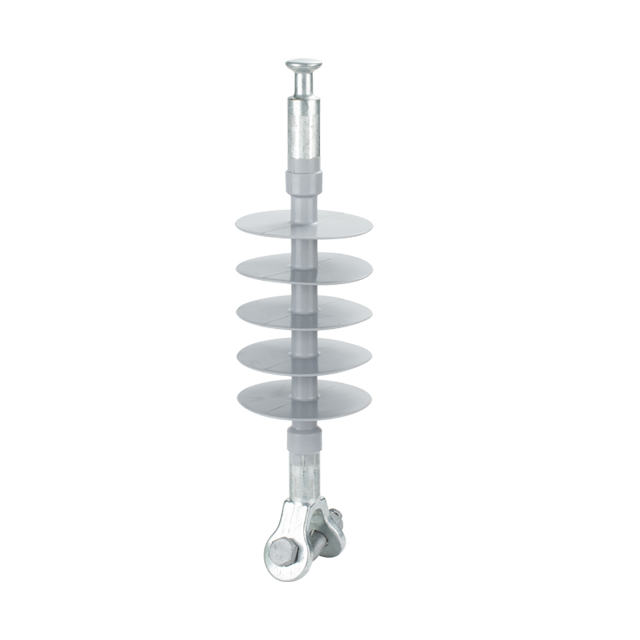
A composite suspension insulator is a highly engineered grid component designed to physically support overhead power transmission lines. At the same time, it electrically isolates the live, energized conductors from the grounded utility towers. Unlike traditional, homogeneous insulators made entirely of fired porcelain or tempered glass, these modern variants are manufactured using a synergistic combination of advanced materials. Each layer serves a highly specific structural or electrical purpose.
Why do legacy ceramic strings fail? Weight and pollution. Polymer insulators offer unmatched resistance to vandalism, such as rock throws or bullet impacts, which would instantly shatter a glass string. By mitigating the risk of pollution-induced flashovers, these components keep the power flowing without constant maintenance interventions.
To truly grasp the reliability of these devices, field engineers must examine their anatomy. A composite insulator is not a single, solid block. Rather, it relies on the flawless integration of three distinct, highly specialized components working in unison.
The internal spine of the assembly is the Fiberglass Reinforced Plastic core, commonly referred to as FRP. Manufactured through a highly controlled pultrusion process, this rod combines premium epoxy resin with millions of unidirectional glass fibers. Its primary job is to bear the entire mechanical tension load of the suspended power lines. When utility crews tension a new span, this core takes the brunt of the physical stress.
Because transmission lines exert immense physical forces due to conductor weight, gale-force winds, and winter ice accumulation, the core must possess extraordinary tensile strength. Advanced profiles are engineered to be significantly stronger than steel of the equivalent weight, all while maintaining absolute electrical insulation. To prevent internal degradation over time, premium cores use ECR glass formulated to resist acid corrosion. For a closer look at the technical specifications of these crucial structural components, you can evaluate a standard FRP Core Rod for Composite Insulators used in utility-scale applications.
Encapsulating the fragile fiberglass core is the weather shed system. Typically molded from HTV silicone rubber, this polymeric sheath serves as the frontline defense against environmental degradation.
The housing shields the internal core from ultraviolet radiation, driving rain, and airborne contaminants. Crucially, the alternating shed design provides the necessary creepage distance. This is the shortest path along the surface of the insulator between the live wire and the grounded hardware. Extending this distance prevents electrical leakage currents from creeping across the surface. Engineers consistently specify a high-grade Silicone Rubber Insulator Housing due to its exceptional tracking resistance and unique self-cleaning characteristics.
Capping both ends of the insulator are the metal hardware pieces. Forged from high-grade steel and finished with hot-dip galvanization to prevent rust, these serve as the physical bridge connecting the insulator to the tower structure above and the conductor clamp below.
Attaching these metal fittings to the FRP core is arguably the most critical step on the factory floor. Top-tier manufacturers utilize advanced coaxial crimping technology. Picture a 160kN load pulling on the line; the crimp must hold fast. The machinery applies uniform, multi-directional pressure to compress the metal onto the rod without crushing the microscopic glass fibers inside. Flawless Composite Suspension Insulator End Fittings ensure that mechanical loads are safely and efficiently transferred through the entire assembly.
The flawless operation of a polymer insulator hinges entirely on the specific material science behind the silicone housing and the reinforced fiberglass spine.
Why does silicone outperform porcelain? The answer lies in hydrophobicity. When heavy rain falls on a traditional porcelain insulator, the water tends to film out, creating a continuous, wet sheet. If that surface is coated in industrial exhaust or coastal salt fog, that wet sheet becomes highly conductive. This inevitably leads to a flashover and a localized power outage.
Silicone rubber behaves entirely differently. It forces moisture to bead up into isolated, disconnected droplets. Because the water cannot form a continuous path, leakage currents are stopped in their tracks. Beyond basic water repellency, silicone exhibits a fascinating trait called hydrophobicity transfer. Low molecular weight siloxanes within the rubber slowly migrate to the surface over time. They actively envelop dirt and pollution particles, rendering the grime layer itself water-repellent.
Structurally, the grid's mechanical integrity relies on the FRP core's ability to handle the Specific Mechanical Load. The unidirectional alignment of glass fibers ensures the rod can withstand immense pulling forces without stretching. The manufacturing challenge lies in ensuring the epoxy matrix remains completely free of microscopic air voids. Even a tiny air gap can trigger partial electrical discharges, slowly eating away at the core from the inside out.
From an operational standpoint, the most vulnerable zone of any composite unit is the triple point. This is the exact interface where the metal end fitting, the silicone housing, and the FRP core intersect. If the sealing system fails here, moisture sneaks into the core. In high-voltage environments, corona discharge converts this trapped moisture and air into nitric acid. This acid rapidly attacks the glass fibers, culminating in brittle fracture—a catastrophic failure where the core snaps cleanly at surprisingly low mechanical loads. Therefore, redundant vulcanized sealing is a non-negotiable manufacturing requirement.
The physical dimensions of a composite unit directly dictate its voltage capacity. Grid engineers must meticulously match the insulator's electrical specifications to the network's operational voltage and local environmental stressors.
In medium-voltage distribution networks, power is routed through dense urban neighborhoods, suburban developments, and sprawling rural areas. Insulators here must be compact, unobtrusive, and highly reliable. Because these lines frequently run adjacent to trees, commercial buildings, and busy roadways, the lightweight and shatterproof nature of polymer units is a massive logistical advantage.
For standard distribution grids, utility planners typically specify a 15kV Polymer Suspension Insulator. These compact components provide ample creepage distance for typical environments while keeping the payload on wooden or concrete poles to an absolute minimum. However, in regions experiencing moderate industrial pollution or slightly higher voltage requirements, upgrading to a 24kV rating provides an essential extra margin of safety. This slight upscale in insulation drastically reduces the likelihood of nuisance tripping during severe thunderstorms or prolonged foggy mornings.
High-voltage transmission lines are the heavy-duty arteries of the grid. They transport massive amounts of electricity across vast geographic expanses. At 145kV and above, electrical stresses increase exponentially. This necessitates significantly longer insulator strings with extensive creepage distances to prevent flashovers.
Heavy-duty polymer suspension insulators for these applications are specifically engineered with a robust FRP core capable of supporting heavy bundle conductors across wide river crossings or mountain spans. The silicone housing on these high-voltage models frequently features alternating shed profiles—a strategic mix of large and small diameter skirts. This intelligent geometry breaks up the flow of heavy rain, preventing water from bridging the gap between adjacent sheds and short-circuiting the system.
For procurement managers evaluating grid hardware, international standards serve as the absolute baseline for safety and compatibility. To ensure grid stability, buyers must source materials that strictly comply with IEC 61109. This is the primary regulatory framework established by the International Electrotechnical Commission for composite suspension and tension insulators on AC systems above 1,000V.
Unlike traditional homogeneous ceramics, a composite unit's survival relies on the integrity of multiple material interfaces. IEC 61109 was specifically developed to simulate decades of brutal environmental stress and dynamic mechanical loading. Achieving this certification requires a product to survive a punishing hierarchy of tests.
Test Category | Primary Objective | Key Evaluations Included |
|---|---|---|
Design Tests | Verify the suitability of materials and overall design geometry. | Tracking and erosion resistance, UV weathering, core flammability, and 1,000-hour water immersion. |
Type Tests | Confirm that a specific insulator profile meets all rated capacities. | Dry lightning impulse voltage, wet power frequency withstand, and damage limit proofs for the core. |
Sample Tests | Ensure tight consistency across a mass-production batch. | Dimensional verification, galvanizing thickness checks, and Specific Mechanical Load destruction tests. |
Routine Tests | Identify manufacturing defects on every single unit before shipping. | Visual inspections and routine mechanical load tests, pulling the unit to 50 percent of its rated capacity. |
Beyond baseline IEC requirements, top-tier manufacturing facilities deploy automated acoustic emission monitoring during the end-fitting crimping process. These highly sensitive microphones listen for the microscopic sound of fracturing fiberglass in real-time. If a single glass fiber snaps during compression, the unit is instantly flagged and rejected. This ensures absolute structural reliability before the batch ever leaves the factory.
Selecting the correct polymer insulator requires a calculated, systematic approach. Issuing a purchase order for the wrong specification can lead to premature mechanical failure, dropped lines, and wildly expensive emergency dispatch calls. Use this structured criteria to guide your procurement process.
Step 1: Determine the System Voltage. The insulator's rated voltage must comfortably exceed the highest operational voltage of the grid. This primary metric dictates the overall length of the unit and the minimum dry arcing distance required to physically separate the energized wire from the grounded steel tower.
Step 2: Calculate the Specific Mechanical Load. The mechanical rating must surpass the maximum anticipated tension from the conductor. Engineers calculate the sheer weight of the wire span, then add aggressive safety margins for dynamic environmental factors like maximum historical wind velocity and worst-case radial ice accumulation. Standard mechanical ratings typically fall into 70kN, 100kN, 120kN, or 160kN brackets.
Step 3: Assess Pollution Level and Creepage Distance. Environmental contamination is a leading cause of outages. IEC 60815 classifies Site Pollution Severity from Light to Very Heavy. If the installation site is near a salty coastline, a dusty agricultural hub, or a smoggy industrial zone, you must specify an extended creepage distance. Alternating shed profiles are highly recommended for Very Heavy pollution zones to disrupt water cascading.
Step 4: Select End Fitting Types. The metal hardware must seamlessly integrate with the utility's existing tower brackets and conductor clamps. The Ball and Socket configuration is the universal go-to for flexible high-voltage transmission articulation. Clevis and Tongue designs are frequently deployed in dead-end tension applications. Matching these dimensions accurately prevents frustrating delays when field crews arrive on site.
The widespread adoption of polymer components over the last thirty years is driven by hard, empirical field data. The Total Cost of Ownership for composite units is demonstrably lower than their porcelain counterparts. This is largely due to massive operational efficiencies.
When it comes to installation logistics, the advantages are immediate. Payload capacities on utility trucks are freed up. Linemen can easily maneuver them into place while suspended in bucket trucks without relying on heavy winches or cranes. In remote, mountainous terrain where hardware must be delivered via helicopter drops or carried manually up steep inclines, the savings in logistical labor can entirely offset the initial purchase price of the insulators.
Maintenance costs also plummet. In heavily polluted regions, utility companies historically spent fortunes on scheduled live-line washing. Thanks to the inherent hydrophobicity and continuous siloxane migration of the silicone rubber housing, composite units are virtually maintenance-free. Natural rainfall is usually sufficient to wash away accumulated dirt without allowing conductive films to form.
The long-term reliability of a composite suspension insulator is entirely dependent on the seamless synergy of its three core components. The high-strength fiberglass core provides the unyielding mechanical backbone. The silicone weather sheds offer an impenetrable, self-cleaning defense against the elements. Finally, the precision-crimped end fittings ensure a secure connection to the grid infrastructure.
For modern utility networks, transitioning to polymer technology is a structural necessity. Choosing high-quality, IEC-compliant materials guarantees grid stability, drastically reduces installation fatigue, and virtually eliminates ongoing maintenance costs. Ready to upgrade your overhead lines? Evaluate your specific voltage and environmental needs, then explore the full range of high-performance hardware at https://www.langaopower.com to find the exact match for your next grid project.
While both utilize the exact same advanced materials and pultrusion processes, their application differs. Suspension insulators are hung vertically from the tower crossarm to support the downward gravitational weight of the conductor. Tension insulators, sometimes called strain insulators, are installed horizontally at dead-end towers or sharp line angles to withstand the massive horizontal pulling force of the tensioned wire.
All polymer materials will experience some degree of aging when exposed to decades of harsh weather. However, high-quality HTV silicone rubber is chemically engineered to be highly resistant to UV radiation, ozone, and electrical surface tracking. Modern silicone retains its crucial hydrophobic and self-cleaning properties for 20 to 30 years.
Brittle fracture is a highly specific, catastrophic mechanical failure. It occurs when the protective sealing system at the end fitting is compromised, allowing ambient moisture to penetrate the internal fiberglass core. High-voltage electrical fields convert this moisture into nitric acid, which rapidly eats away at the epoxy resin and glass fibers. Specifying acid-resistant core rods and redundant vulcanized seals prevents this phenomenon.
Pollution severity directly dictates the required creepage distance of the insulator. In areas with heavy industrial smog or coastal salt spray, contaminants coat the insulator surface. To prevent these contaminants from creating a conductive path that leads to a flashover, engineers must select insulators with a longer creepage distance and alternating shed profiles to disrupt moisture flow.
Absolutely. High-quality silicone rubber maintains its flexibility and hydrophobic properties even in sub-zero temperatures. Unlike porcelain, which can crack under severe freeze-thaw cycles, polymer insulators easily accommodate thermal contraction. Furthermore, their slick surface makes it difficult for heavy radial ice to accumulate, reducing the overall mechanical strain on the tower.