Address
Nanzhai village, Liushi Town, yueqingCity, zhejiang Province, china
Tel
+86-13375775325
Views: 0 Author: Site Editor Publish Time: 2026-06-24 Origin: Site

Grid operators and utility engineers face mounting pressure today. You constantly seek methods to reduce line losses. You must also prevent surface flashover in severely polluted environments. Furthermore, lowering installation hurdles remains a daily priority. The industry shift from traditional porcelain or glass units to silicone rubber alternatives directly answers these challenges. However, this transition requires a clear understanding of material trade-offs.
What works perfectly in a pristine rural grid might fail in a coastal salt-fog zone. This guide deconstructs modern composite insulators. We provide procurement and engineering teams an evidence-based framework. You will learn how to evaluate physical structures and verify manufacturer performance claims. Ultimately, you will understand true implementation realities before deploying these critical grid assets.
Structural Efficiency: A core composite insulator combines an FRP (Fiberglass Reinforced Plastic) core for tensile strength with a silicone rubber housing for weathering, reducing weight by up to 90% compared to porcelain.
Contamination Performance: Inherent hydrophobicity prevents continuous water filming, significantly reducing the risk of wet flashover in heavy pollution or coastal zones.
Strategic Application: While highly effective for minimizing voltage drops and lowering tower payloads, buyers must evaluate long-term aging risks and verify IEC testing compliance before mass deployment.
Form Factor Variations: Selecting between a composite suspension insulator (vertical load) and a polymer tension insulator (horizontal/strain load) dictates hardware configuration and tower placement.
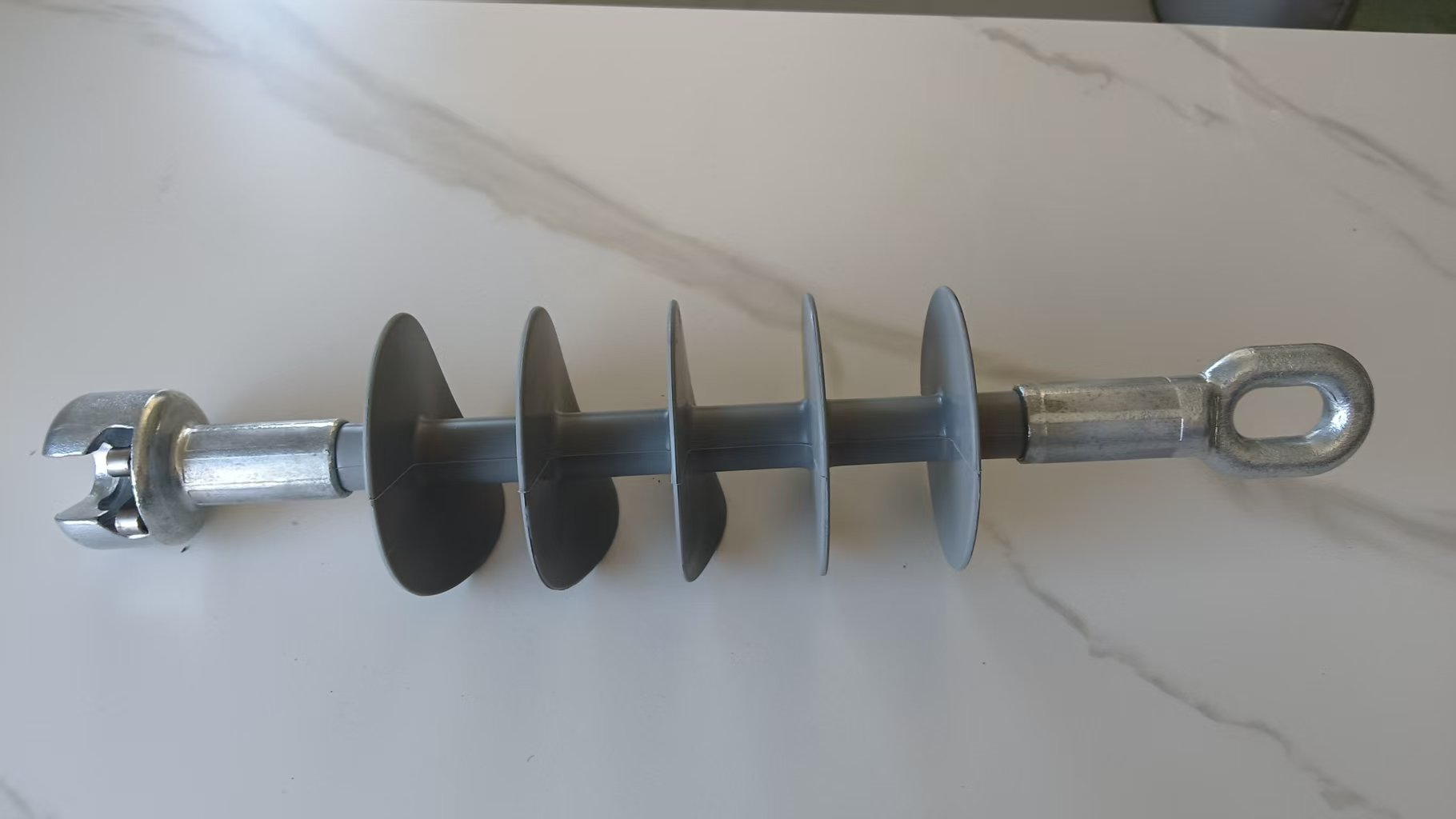
Understanding the anatomy of a composite unit prevents costly procurement mistakes. Engineers must look beyond surface aesthetics. You need to scrutinize the underlying materials. A reliable unit relies entirely on three integrated components. Each component presents unique failure points and quality indicators.
FRP Core (Epoxy Resin & Glass Fiber)
The Fiberglass Reinforced Plastic (FRP) core acts as the mechanical backbone. Manufacturers bundle unidirectional glass fibers and bind them using epoxy resin. This core bears all mechanical tension. However, it remains highly vulnerable to environmental ingress. Moisture penetration can lead to catastrophic brittle fracture. Corona discharge can also generate nitric acid near the fittings. This acid actively attacks the glass fibers. Procurement teams must request ECR-glass (boron-free) cores to maximize acid resistance.
Silicone Rubber Housing (Sheath & Sheds)
The external housing protects the internal core. It features an aerodynamic shed design to maximize creepage distance. This extended surface pathway prevents electrical currents from arcing across the unit. Quality evaluations heavily depend on tracking and erosion resistance. High-grade HTV (High-Temperature Vulcanized) silicone rubber performs best here. It actively resists degradation caused by continuous UV exposure and electrical stress.
Metal End Fittings
Fittings connect the FRP core to the transmission tower hardware. Manufacturers typically attach these metal ends using advanced radial crimping technology. Proper crimping requires precise force. Over-crimping crushes the glass fibers. Under-crimping allows the rod to slip under heavy mechanical loads. Top-tier manufacturers utilize acoustic emission testing during the crimping process. These acoustic sensors detect microscopic fiber breakage instantly. This testing ensures maximum crimp integrity without inflicting core damage.
Physical features mean little unless they translate into measurable grid-level outcomes. Utility teams deploy polymer units primarily to reduce power drop and streamline maintenance cycles. Let us examine the core performance metrics driving these outcomes.
Silicone rubber possesses an inherent ability to repel water. We call this hydrophobicity. Low molecular weight (LMW) silicones constantly migrate from the bulk material to the outer surface. When moisture hits the sheds, this chemical layer breaks the water into isolated droplets. It prevents continuous conductive water films from forming.
This mechanism drastically reduces wet flashover risks. Even in heavily polluted areas covered in industrial dust, the LMW silicones encapsulate the dirt. The surface dynamically recovers its water-repellent properties over time.
Polymer units weigh up to 90% less than equivalent porcelain strings. This extreme weight reduction completely changes logistics. Crews experience easier handling during installation. Breakage during transport drops to near zero. Furthermore, lighter payloads allow engineers to design lighter, more cost-efficient transmission towers.
Traditional ceramic and glass units shatter easily upon impact. Rocks or gunshots routinely destroy rural grid components. Polymer materials do not shatter. A direct impact might tear a silicone shed, but it rarely compromises the internal core. The line remains operational, allowing maintenance crews to schedule replacements proactively.
Performance Metric | Composite (Silicone/FRP) | Traditional (Porcelain/Glass) |
|---|---|---|
Weight Profile | Extremely light (up to 90% lighter) | Extremely heavy (requires heavy lifting gear) |
Hydrophobicity | Excellent (self-recovering LMW silicones) | Poor (forms continuous water films) |
Impact Resistance | High (puncture/tear, but non-shattering) | Low (brittle, shatters entirely on impact) |
Maintenance Needs | Low (self-cleaning in rain) | High (requires periodic manual washing) |
Grid placement dictates your hardware configuration. You cannot use components interchangeably. Understanding mechanical load directions ensures safe and reliable line architecture.
Engineers deploy a composite suspension insulator vertically. This unit hangs directly downward from the cross-arm of the transmission tower. It carries the vertical weight of the conductor on straight line runs. Because the primary stress involves holding the wire up, the mechanical demands differ from angle towers. You will mostly encounter these units along flat, linear transmission corridors. Their long, single-piece construction prevents the voltage drops often seen across multiple porcelain bell joints.
Conversely, grid layouts require a polymer tension insulator where the line ends or turns sharply. Crews install these units horizontally or at steep angles. They withstand the high tensile pull of conductors at dead-ends, sharp corners, or heavy river spans.
Evaluation Note: Buyers must specify significantly higher Specified Mechanical Load (SML) ratings for tension applications. Horizontal stress acts continuously on the FRP core. Any weakness in the crimped end fittings will cause line failure under high wind or ice loading scenarios.
Where does the investment in modern composite materials yield the highest performance returns? Smart grid operators deploy these units strategically to solve specific environmental and structural challenges.
High-Pollution and Coastal Zones: We consider this the primary use case. Salt-fog, industrial smog, and agricultural dust quickly coat overhead lines. Traditional ceramics require constant washing to prevent arcing. Silicone rubber utilizes its self-cleaning properties. Rain easily washes encapsulated dirt away, keeping the grid secure without manual intervention.
EHV and UHV Lines (Extra/Ultra High Voltage): Scaling a network from 500kV to 1000kV+ demands massive creepage distances. Using multi-bell porcelain strings for UHV creates excessively heavy payloads. Composite insulators feature a scalable, single-rod length. They easily support ultra-high voltages without adding dangerous weight to the towers.
Urban & Compact Corridors: Space remains a premium in growing cities. Utility companies utilize polymer structures to reduce tower window sizes. Because composite units resist flashovers better, engineers can narrow the right-of-way footprint safely. This compact design logic helps utilities navigate strict urban zoning laws.
Despite their immense benefits, silicone materials present operational risks. Building a trustworthy grid requires rigorous due diligence. You must address material limitations directly.
Silicone rubber degrades over decades. Extreme UV exposure breaks down the polymer chains. Continuous corona discharge also generates ozone, which attacks the rubber surface. While LMW silicones recover hydrophobicity, severe aging eventually exhausts this capability. The sheds may become chalky, brittle, or discolored. You should monitor aging units closely after fifteen years of intense environmental exposure.
Wildlife poses a real-world operational risk. Birds occasionally mistake soft rubber sheds for nesting materials. Rodents have also been known to gnaw on the silicone flanges. While this rarely severs the structural core, it destroys the creepage distance. Damaged sheds invite water pooling, which eventually leads to electrical tracking and premature failure.
Procurement teams must demand strict quality assurance. You should shortlist several non-negotiable standard tests. Buyers must request verification from reputable independent laboratories.
IEC 61109 Compliance: This standard governs composite suspension and tension insulators for AC overhead lines. It mandates rigorous mechanical and electrical test parameters.
1000-Hour Tracking and Erosion Test: This prolonged test subjects the silicone housing to continuous electrical stress and saline mist. It ensures the rubber will not erode prematurely in coastal zones.
Steep-Front Wave Test: Laboratories apply rapid, high-voltage impulses to the unit. This test verifies the crucial internal seal between the FRP core and the silicone housing. If the seal fails, the steep-front wave will cause internal puncture.
Transitioning to advanced materials secures a more reliable and resilient power grid. You can drastically cut maintenance cycles by leveraging inherent hydrophobicity.
Shortlisting Logic: Composite insulators clearly stand as the optimal choice for high-pollution environments. They also excel in weight-sensitive and extra-high-voltage applications. However, success depends entirely on meeting rigorous manufacturing standards.
Verify Core Integrity: Always confirm manufacturer crimping techniques. Demand acoustic emission testing protocols to guarantee core strength.
Next Steps: We encourage buyers to request third-party lab testing reports. Look for independent certifications from entities like KEMA. Review long-term operational data from manufacturers before committing to bulk infrastructure upgrades.
A: The main difference lies in the load direction they support. A suspension unit bears the vertical weight of the conductor. Crews hang it straight down. A strain (or tension) unit bears the horizontal pull of the wire. Crews install it horizontally at dead-ends or sharp corners.
A: A high-quality composite unit typically lasts 15 to 25 years in the field. Lifespans depend heavily on environmental severity. High UV exposure, continuous corona discharge, and extreme coastal pollution can accelerate silicone degradation. Avoid manufacturers making exaggerated "lifetime" claims.
A: No, they generally do not require manual cleaning. Silicone rubber features a hydrophobic surface. It actively repels water and encapsulates dirt. When it rains, water droplets roll off, washing away surface contamination. This self-cleaning nature eliminates the expensive washing routines required by traditional porcelain units.