Address
Nanzhai village, Liushi Town, yueqingCity, zhejiang Province, china
Tel
+86-13375775325
Views: 0 Author: Site Editor Publish Time: 2026-06-12 Origin: Site

Power grids worldwide face intensifying operational demands today. Modern infrastructure requires highly reliable solutions to prevent costly and dangerous outages. Traditional ceramic and glass components often struggle in highly polluted environments. They suffer from frequent electrical flashovers and demand heavy installation overhead. We must transition to more resilient, lightweight alternatives to secure long-term grid reliability.
You will discover how a composite insulator directly addresses these exact utility challenges. We move beyond basic industry definitions to provide engineers and procurement teams a precise technical breakdown. You will learn exactly how these units function, why they sometimes fail, and how to rigorously evaluate them for critical grid upgrades. The core value of these modern units lies in their highly engineered dual-material construction. They brilliantly separate electrical shielding responsibilities from mechanical load-bearing tasks, creating a superior asset for modern power transmission.
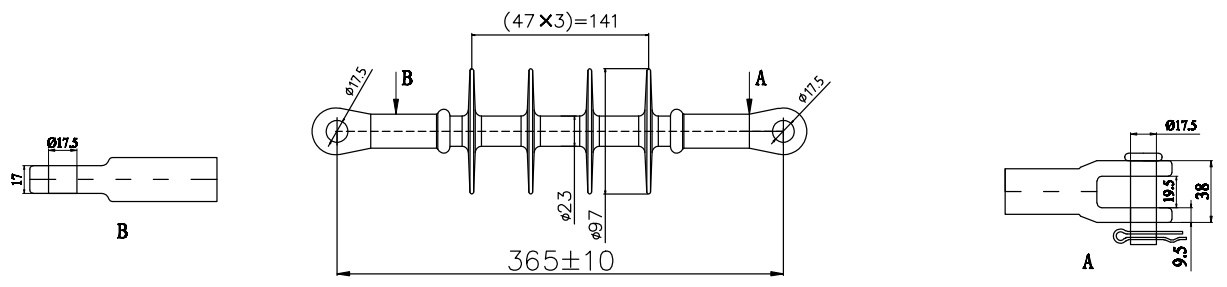
Anatomy: A composite insulator relies on a fiberglass core for mechanical strength and a silicone rubber housing for electrical shielding.
Performance Mechanism: The primary operational advantage is "hydrophobicity transfer"—the ability of the silicone housing to encapsulate dirt and prevent continuous water films, drastically reducing leakage currents.
Weight & Installation: They weigh up to 90% less than porcelain equivalents, lowering structural tower requirements and logistics costs.
Evaluation Baseline: Procurement viability depends heavily on verifiable compliance with IEC 61109/62217 standards and the precision of the end-fitting crimping process.
A polymeric unit consists of three highly specialized components working together. Each part handles a distinct operational stress factor. We see this distinct separation of function as their greatest engineering advantage over monolithic glass.
The core relies entirely on an epoxy-impregnated glass fiber rod, commonly manufactured through a continuous pultrusion process. It acts as the absolute mechanical backbone of the entire assembly. It handles the primary tensile load acting on the hardware. The high-strength fiberglass strands prevent mechanical separation under extreme line tension. You rely on this core to hold the physical weight of the suspended conductors.
Manufacturers wrap the delicate core in High-Temperature Vulcanized (HTV) silicone rubber or EPDM. This outer layer creates the essential weather-sheds. The highly aerodynamic shed profile maximizes the surface creepage distance. This specialized shape disrupts moisture buildup effectively. The rubber protects the underlying epoxy rod from harsh UV radiation and environmental degradation.
End fittings create the vital physical interface for the hardware. They connect the insulator securely to both the support tower and the live conductor. The industrial crimping process requires absolute manufacturing precision. The "triple-point junction" marks the exact microscopic spot where air, metal, and polymer meet. Engineers view this specific junction as a primary failure risk zone. Poor crimping easily allows moisture ingress here, which destroys the unit from the inside out.
High-voltage transmission environments push physical materials to their absolute limits. These advanced units rely on both physical design and chemical mechanisms to survive decades of continuous use.
Polymeric sheds intentionally disrupt continuous downward water paths. Heavy rain cannot form a unified, conductive water film on the outer surface. They rely on an amazing chemical property called hydrophobicity recovery. Low-molecular-weight siloxanes constantly migrate from deep inside the silicone material to the outer surface. This microscopic chemical migration maintains strong water repellency over time. It powerfully prevents leakage currents even under heavy industrial or coastal pollution.
The internal FRP core continuously manages intense physical forces. It distributes tensile, compressive, and cantilever loads safely across its length. The specialized fiberglass matrix resists internal micro-fracturing during constant wind vibrations and ice loading. You depend on it to bend slightly without ever snapping under sudden shock loads.
High-voltage applications exceeding 115kV naturally generate intense electric fields at the hardware ends. These concentrated fields easily cause destructive corona discharge. Engineers must install metallic corona rings to manage this severe electric field stress. The rings distribute the electrical field evenly, preventing premature aging of the silicone polymer near the end fittings. Without them, localized dry-band arcing would quickly erode and destroy the sensitive rubber housing.
Engineers specify different physical profiles based on specific mechanical load directions. The power grid uses three primary configurations to route energy safely.
A composite suspension insulator hangs live conductors vertically downward from transmission towers. They excel heavily in long-distance, high-voltage transmission lines. Their massive weight reduction significantly impacts overall tower engineering. Lighter suspended lines allow structural engineers to design slimmer, more cost-effective support towers across the grid.
Dead-end towers and sharp transmission line angles require highly specialized hardware. A polymer tension insulator handles severe and constant horizontal mechanical loads. They maintain essential conductor tension safely across long river crossings or valleys. Specified Mechanical Load (SML) ratings heavily dictate your engineering selection here. You must match the SML strictly to expected horizontal line pulls.
Substations and neighborhood distribution poles require stiff, rigid mounting solutions. Line post units provide this unyielding structural support. Cantilever bending strength becomes your primary evaluation metric here. They must firmly resist lateral bending forces from heavy aluminum busbars and harsh storm winds without flexing.
Deciding between modern polymeric options and traditional porcelain requires looking at distinct operational pros and cons. You must weigh these factors for your specific climate.
Evaluation Metric | Composite Insulators | Porcelain & Glass Insulators |
|---|---|---|
Weight & Handling | Exceptionally lightweight; easy manual installation. | Extremely heavy; often requires heavy crane equipment. |
Pollution Performance | Excellent due to natural hydrophobicity transfer. | Poor; requires frequent manual washing regimens. |
Vandalism Resistance | Shatterproof; absorbs projectile impacts well. | Highly fragile; shatters completely upon sharp impact. |
Failure Inspection | Difficult; internal core damage hides easily. | Easy; glass clearly shatters leaving visible stubs. |
Logistics: You gain an incredible 70-90% overall weight reduction. This directly leads to faster, crane-free manual installations. It dramatically lowers cross-country transportation and freight costs.
Maintenance: The self-cleaning silicone completely eliminates the need for regular manual washing. This saves vast utility resources in highly polluted, dusty, or coastal environments.
Vandalism: Polymeric units feature extremely high impact resistance. They remain virtually shatterproof against rocks or gunfire, which reduces your emergency replacement frequency significantly.
You must carefully balance the clear benefits against specific operational realities. They are not perfect for every single scenario.
Handling Fragility: The silicone surface feels relatively soft. It remains highly susceptible to surface gouging from rough mishandling during transport. Bird pecking or rodent damage can easily compromise the protective weather-sheds.
Lifespan Ambiguity: Traditional glass components shatter visibly upon failure, making helicopter inspections easy. Polymeric units are much harder to visually inspect from afar. Internal degradation, like brittle fracture, hides completely beneath a perfectly intact rubber surface.
Procurement teams must strictly adhere to established international industry standards. You cannot guess when specifying grid-level infrastructure.
SML stands directly for Specified Mechanical Load. RTL means Routine Test Load. Specifiers must always match their operational tower loads to these strict thresholds. You should apply appropriate safety margins during design. You must never let everyday line tension exceed the RTL threshold, as this causes long-term structural fatigue.
Polymer housings face continuous surface electrical stress from the environment. The standard inclined-plane test accurately measures surface tracking resistance. It rigorously evaluates how the silicone material handles prolonged electrical arcing without eroding or catching fire. Only highly formulated HTV silicone passes this sustained test.
You need clear, unyielding baselines for your vendor procurement shortlisting.
IEC 61109: This dictates absolute rules for suspension and tension composite units. It governs their mechanical and electrical testing protocols.
IEC 62217: This defines the general polymeric material requirements. It covers weathering, UV aging, and water immersion tests.
You should never procure units failing to meet these non-negotiable international standards.
Buying faulty line hardware risks catastrophic, cascading grid failure. You must verify vendor manufacturing quality actively during your procurement cycle.
Buyers must heavily evaluate the manufacturer's specific end-fitting attachment process. You should look for acoustic emission (AE) testing implementation during the factory crimping phase. AE testing ensures the hydraulic crimping machine did not accidentally micro-fracture the delicate FRP core beneath the metal.
The interface seal between the metal fitting and the silicone housing remains hyper-critical. A poorly designed seal rapidly allows moisture ingress directly into the unprotected fiberglass core. This trapped moisture represents the primary, root cause of dangerous core decay and sudden brittle fracture on the line.
Take these practical, evidence-based steps before committing to final procurement:
Request comprehensive, independent third-party type test reports from certified laboratories.
Evaluate specific vendor warranty terms related directly to UV degradation and surface chalking.
Conduct random sample material audits and destructive factory testing before authorizing bulk installation.
Adopting these advanced units represents a fundamental, necessary industry shift. We actively move away from relying on raw material mass like bulky porcelain. Instead, we embrace advanced material science using highly specialized polymers and aerospace-grade fiberglass. The combination yields a much smarter, more adaptable grid asset.
While upfront unit costs will certainly vary by manufacturer and region, the broader operational benefits remain completely undeniable. You gain incredible installation speed on difficult terrain. You see drastically reduced flashover outage rates in heavily polluted industrial areas. You achieve a near zero-washing maintenance reality for your line crews. These powerful, measurable performance factors make polymeric solutions the standard, intelligent choice for any modern grid expansion or reliability upgrade.
A: A high-quality unit typically lasts 15 to 25 years under standard operational conditions. The actual lifespan depends heavily on prolonged UV exposure, local pollution levels, and sustained electrical stress. Premium HTV silicone formulations generally push lifespans toward the higher end of this spectrum by resisting surface chalking.
A: Brittle fracture is a dangerous, sudden failure mode. It occurs when atmospheric acid or moisture breaches the end-fitting seal and enters the core. The moisture chemically reacts with the stressed fiberglass under high tension, causing the rod to snap cleanly with almost no visual warning.
A: Recycling them presents a significant challenge. The tightly bonded combination of epoxy-glass fiber and vulcanized silicone rubber is notoriously difficult to separate. Currently, most end-of-life units end up in specialized industrial landfills, though some new mechanical grinding methods are emerging for downcycling the materials.
A: They need corona rings to safely manage intense electric field stress at higher voltages. Typically required on lines above 115kV, these metal rings provide field grading. They prevent localized dry-band arcing and corona discharge, which would otherwise quickly erode and destroy the sensitive silicone housing.