Address
Nanzhai village, Liushi Town, yueqingCity, zhejiang Province, china
Tel
+86-13375775325
Views: 0 Author: Site Editor Publish Time: 2026-06-14 Origin: Site

High-voltage grid modernization requires components reducing routine maintenance overhead. Grids also need parts capable of withstanding increasingly harsh environmental conditions. Utilities face mounting pressure globally. They must keep transmission lines operational through extreme weather events. Legacy porcelain and glass historically dominated overhead transmission networks. However, silicone rubber composites now serve as the standard for new installations. These polymer materials effectively resist severe pollution. They also eliminate massive logistical hurdles during tower construction. This guide evaluates the technical and operational advantages of polymer line components. We aim to help engineering and procurement teams make evidence-based specification decisions. You will learn how upgrading your infrastructure improves grid resilience safely.
Superior Pollution Resistance: Inherent hydrophobicity significantly reduces the risk of wet flashovers in coastal and industrial environments.
Drastic Weight Reduction: Weighing up to 90% less than traditional porcelain equivalents, composite units drastically lower transportation costs and simplify live-line installations.
Favorable Lifecycle ROI: Despite variations in upfront costs, the elimination of routine washing and reduced breakage yield a lower Total Cost of Ownership (TCO).
Mitigated Breakage Risks: The flexible, shatter-proof nature of polymer housings reduces damage during transit, installation, and incidents of vandalism.
Legacy porcelain and glass components present ongoing operational challenges for utility managers. Ceramic units suffer from exceptionally high weight. They exhibit extreme fragility during cross-country transport. Utilities constantly battle frequent maintenance demands in highly polluted regions. Maintenance teams must regularly deploy water-washing rigs. Sometimes they apply expensive silicone coatings manually over degraded glass. These traditional practices drain maintenance budgets rapidly. They also expose linemen to unnecessary live-line risks. Heavy glass strings demand massive cranes during tower assembly.
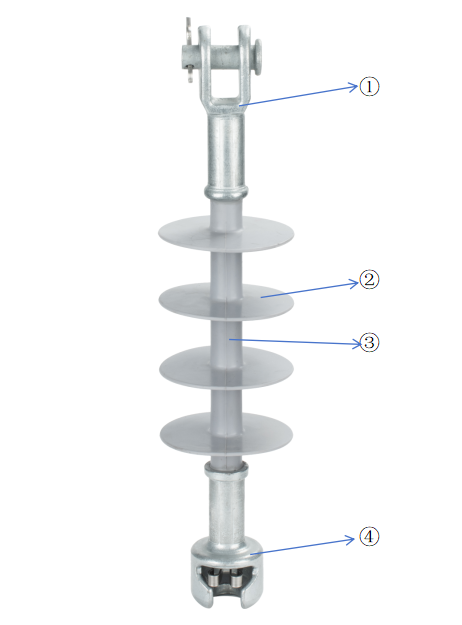
A modern composite insulator solves these fundamental mechanical and environmental problems directly. The design combines a high-strength fiberglass core alongside a weather-resistant silicone rubber housing. Engineers attach galvanized steel end-fittings to complete the unit. This elegant three-part construction addresses critical operational pain points across modern transmission networks. The flexible polymer housing absorbs blunt impacts easily. The core provides tensile strength rivaling solid steel cables.
Evaluating this engineering shift requires tracking specific operational success criteria carefully. Grid operators must measure reductions in line outage frequencies. They should analyze maintenance hour reductions over an annual cycle. Finally, teams need to assess improved ease of installation for ground crews. Shifting away from fragile ceramics streamlines the entire construction workflow.
Material Comparison Chart: Traditional vs. Composite | ||
Feature | Porcelain / Glass | Silicone Composite |
|---|---|---|
Weight Profile | Extremely heavy (requires cranes) | Up to 90% lighter (manual handling) |
Pollution Resistance | Poor (requires frequent washing) | Excellent (hydrophobic and self-cleaning) |
Impact Resistance | Highly fragile (shatters easily) | Shatter-proof (flexible rubber housing) |
Core Strength | Ceramic bulk load bearing | Unidirectional fiberglass reinforcement |
Utility districts adopting polymer solutions notice immediate logistical improvements. Crews load more hardware onto single service trucks. Staging areas require less protective packaging materials. The elimination of heavy lifting equipment speeds up tower rigging significantly. These practical benefits drive the industry away from legacy glass adoption.
Silicone rubber possesses an incredible property known as hydrophobicity. The material actively repels water continuously. It encapsulates surface dirt particles efficiently using low molecular weight siloxanes. These unique chemical compounds migrate directly to the pollution layer surface. Water beads up rather than forming continuous conductive films. This vital chemical action prevents dangerous wet flashovers entirely.
During heavy rain, leakage currents remain remarkably low compared to porcelain counterparts. Ceramic materials allow water to sheet across their surface freely. This sheeting action dissolves accumulated salts rapidly. It creates a highly conductive path straight to the tower ground. This phenomenon increases flashover risks dramatically during sudden thunderstorms. Silicone rubber interrupts this conductive path naturally.
Engineers consistently specify a composite suspension insulator for heavy pollution zones. Various harsh environments challenge grid stability globally:
Coastal Salt Fog: Ocean winds deposit dense sodium chloride layers on transmission lines. Polymer units encapsulate these salts and block conductive moisture tracking.
Industrial Emissions: Chemical plants release sulfur and heavy metal particulates. Silicone housings resist acidic buildup better than standard glass.
Desert Dust: Arid regions blow fine sand across high-voltage infrastructure. Hydrophobic surfaces clean themselves easily during rare rain showers.
Modern high-temperature vulcanized (HTV) silicone rubbers mitigate long-term UV degradation brilliantly. Solar radiation normally destroys synthetic plastics over time. However, HTV formulations incorporate advanced inorganic fillers like alumina trihydrate (ATH). These specific chemical additives resist electrical tracking and surface erosion perfectly. They ensure long-term stability under intense sun exposure. The material prevents carbon tracking even if dry-band arcing occurs. Utilities gain immense reliability across desert and tropical installations alike. The polymer sheds remain flexible and functional for decades.
Polymer components deliver an extraordinary weight-to-strength ratio. Manufacturers utilize a specialized pultrusion process to create the central rod. Millions of individual glass fibers align perfectly parallel inside an epoxy resin matrix. This manufacturing technique produces a core stronger than structural steel. Yet, the final product weighs roughly ten percent of a bulk ceramic equivalent string. A polymer tension insulator provides exceptional tensile strength for dead-end towers. It secures heavy transmission conductors easily minus the excessive bulk. Linemen maneuver these lightweight units safely during challenging live-line operations.
Logistical advantages become immediately apparent during large-scale procurement. Reduced freight tonnage benefits massive cross-country transmission projects heavily. Transporting lightweight polymer units slashes shipping fuel consumption. Construction companies require far less heavy handling equipment at staging yards. Workers carry multiple units manually over steep mountainous terrain. Helicopters can airlift larger batches into remote installation sites safely.
Procurement teams no longer purchase extra inventory for transit damage. The traditional "breakage allowance" vanishes completely from project planning. Historically, managers ordered ten percent extra glass units. They anticipated unavoidable shattering during bumpy truck transport. Flexible rubber sheds eliminate this massive logistical waste entirely. You receive exactly what you order intact.
Vandalism causes massive headaches for rural utility districts worldwide. Hunters occasionally shoot at overhead power lines. Blunt impacts shatter glass and porcelain strings instantly. Shatter-proof polymer properties prevent these catastrophic string failures. Bullets might pierce the outer silicone shed. However, the inner fiberglass core usually remains structurally intact. This mechanical resilience keeps power flowing despite localized damage. It prevents live conductors from dropping dangerously onto public roads.
Procurement teams must understand specific engineering implementation risks. Brittle fracture represents a critical threat to fiberglass cores. High-voltage corona discharges can generate nitric acid in moist atmospheric conditions. This acid attacks standard glass fibers rapidly inside the core rod. The acid leaches calcium from the glass matrix. A smooth, clean break occurs suddenly under normal mechanical tension. Therefore, engineers must absolutely specify Boron-free, corrosion-resistant (ECR) glass fibers. ECR cores prevent catastrophic line drops in high-voltage applications entirely.
End-fitting seal integrity dictates the entire unit service lifespan. Manufacturers attach galvanized metal hardware using advanced multi-directional crimping technology. Poor sealing allows moisture ingress directly into the core rod interface. This trapped moisture causes internal electrical tracking rapidly. It bypasses the external silicone housing completely. Ultimate mechanical failure inevitably follows poor crimping processes. Over-crimping crushes the delicate fiberglass matrix. Under-crimping allows the rod to slip out under heavy ice loads.
You should enforce strict supplier shortlisting criteria systematically. We recommend establishing the following mandatory QA requirements before vendor approval:
Require full compliance for IEC 61109 and IEC 61952 international standards.
Demand verifiable third-party testing data from accredited independent laboratories.
Request specific 1000-hour tracking and erosion test reports for the silicone mixture.
Audit the manufacturer's acoustic emission testing methods used during the end-fitting crimping stage.
Verify the supplier uses genuine ECR glass for all core rod manufacturing.
These rigorous steps guarantee high quality and long-term grid safety. Accepting unverified generic polymer units invites severe operational disaster. Premium materials combined alongside verified manufacturing processes ensure flawless grid performance. Thorough technical audits separate reliable manufacturers from substandard assemblers.
Composite materials offer a pragmatic, high-performance alternative to traditional ceramics. They directly address heavy operational burdens placed upon modern utility operators. Transitioning to silicone rubber improves overall grid resilience against extreme weather. It entirely eliminates costly routine washing schedules in heavy pollution zones. Lightweight polymer units also improve workplace safety for installation crews dramatically. They streamline logistics from the factory floor straight to the transmission tower.
Engineering teams should immediately audit their current line maintenance operations. Identify specific regions suffering from high pollution wet flashovers. Request sample testing data from reputable polymer manufacturers today. Review technical datasheets carefully for upcoming transmission project phases. Ensure your specified products utilize ECR glass and advanced HTV silicone. Upgrading your infrastructure systematically ensures reliable power delivery for future generations.
A: Porcelain units can theoretically last 40 years or more. However, harsh environmental factors often degrade their practical lifespan. Composites typically offer a 15 to 25-year highly reliable service life. They deliver this longevity without demanding heavy routine maintenance overhead. This operational reality makes silicone rubber highly attractive for modern power grids aiming to reduce physical labor.
A: Yes, avian damage presents an occasional risk. Cockatoos and woodpeckers sometimes chew on the soft silicone sheds. Rodents might also bite the rubber housing during warehouse storage. However, you can install specialized metallic mitigation guards to deter wildlife. Proper indoor storage practices also prevent pest damage before field installation.
A: Absolutely. Manufacturers design the internal fiberglass core specifically to handle extreme tensile loads. A polymer tension unit secures heavy conductors on dead-end and angle towers perfectly. The specialized multi-directional crimping process transfers massive mechanical stress safely. They consistently match or exceed the breaking strength of bulkier ceramic alternatives.
A: No, they do not require periodic water washing. The silicone rubber features inherent hydrophobic properties continually. It repels water and encapsulates dirt particles autonomously. This advanced material acts as a self-cleaning surface during natural rainstorms. You can safely eliminate expensive routine washing programs across most harsh operating environments.