Address
Nanzhai village, Liushi Town, yueqingCity, zhejiang Province, china
Tel
+86-13375775325

| Quantity: | |
|---|---|
Introduction:
The PA2000 is a specialized type of tension clamp (or dead end clamp) constructed primarily from high-strength engineering plastic. It is designed for terminating, anchoring, and tensioning insulated cables or conductors in overhead utility lines. Its plastic construction offers a modern, efficient alternative to traditional all-metal clamps, providing key advantages in corrosion resistance and cable protection.
Specifications:
Type | Cross section(mm²) |
STA | 1*10/1*16 |
STB | 2*16/2*25 |
STC | 4*16/4*25 |
STD | 1*16/1*70 |
LA1 | 4*16/4*25 |
LA2 | 2*6/2*16 |
DCR-1 | 1*4/1*25 |
DCR-2 | 2*4/2*25 |
2.1 | 16-25 |
PA1500 | 25-50 |
PA2000 | 54.6-70 |
Product Construction & Mechanism:
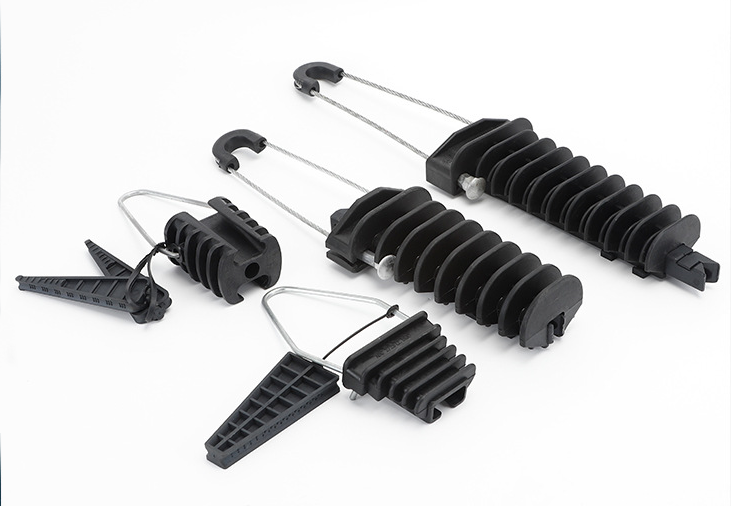
As clearly seen in the image, the PA2000 anchor clamp has a distinct and functional design:
Main Gripping Body (Plastic Segments): The core component is a series of parallel, curved black plastic ribs or segments. These segments form a channel that cradles the main cable. When tension is applied, these segments compress uniformly around the cable, creating a powerful, distributed gripping force without damaging the cable's insulation.
Metallic Eyelet (Anchor Point): One end of the clamp features a galvanized steel eyelet. This serves as the primary anchor point, which would be attached to a pole, tower, or other fixed structure.
Tensioning System: A thin, galvanized steel tensioning wire is connected to the main body. This wire is routed through the segmented plastic body and is secured with two smaller metallic thimbles. A small, cylindrical metal component (likely a locking wedge or adjustment ferrule) is visible where the wire exits the body. This entire system is used to apply and maintain the tension on the cable once the clamp is installed.
How it Works: The main cable is laid into the curved channel of the plastic segments. The tensioning wire is pulled tight, which pulls the segmented body towards the anchor point. This action causes the plastic segments to compress radially and longitudinally, gripping the cable with immense force. The mechanical advantage ensures a secure hold.
Key Features and Advantages:
Superior Cable Protection: The smooth plastic ribs grip the cable with uniform pressure, eliminating the sharp bite points of metal clamps. This is crucial for preventing damage to the insulation of covered or bundled conductors.
Excellent Vibration Damping: The plastic material naturally absorbs and dampens vibrations caused by wind (aeolian vibration), significantly reducing the risk of fatigue failure in the cable at the clamping point.
Complete Corrosion Resistance: Being primarily plastic with only small, galvanized metal components, the PA2000 cable clamp is immune to rust, making it ideal for coastal, industrial, or humid environments. This extends service life and reduces maintenance.
Lightweight: The plastic construction makes it much lighter than equivalent metal clamps, simplifying handling, transportation, and installation, thereby improving worker safety and efficiency.
Self-Tightening/Compensating: The segmented design often provides a self-tightening feature. If the cable experiences creep or slight settling, the clamp can automatically adjust to maintain a constant grip.
Easy Installation: Installation is typically quick and does not require special heavy tools, unlike some bolted or wedge-type metal clamps.
Production Process:
The manufacturing leverages standard industrial processes:
Injection Molding: The complex segmented plastic body is mass-produced with high precision using injection molding. The material is likely a high-impact, UV-stabilized Nylon (Polyamide - which the "PA" in the name may refer to) or a similar durable polymer.
Metal Stamping and Forming: The eyelet and thimbles are fabricated from steel sheet, stamped to shape, and then galvanized for corrosion protection.
Wire Rope Fabrication: The tensioning wire is a pre-formed, cut-to-length galvanized steel wire rope.
Assembly: The various components are assembled into a complete unit ready for installation.
Application Scenarios:
The PA2000 cable connectors is specifically designed for overhead utility lines where a non-destructive, reliable grip is essential:
Aerial Bundled Cable (ABC) Systems: This is a primary application. ABC systems use insulated conductors bundled together, and the PA2000 is perfect for anchoring these bundles at dead-ends or corners without compromising the insulation.
Insulated Service Drops: The connection from the utility pole to a building often uses an insulated cable, which can be securely terminated with this clamp.
Telecommunication and Fiber Optic Cables: For tensioning and supporting the static line or the fiber optic cable itself in overhead installations, where protection of the delicate cable is paramount.
Secondary Distribution Lines: On overhead power distribution networks using covered conductors.