


Address
Nanzhai village, Liushi Town, yueqingCity, zhejiang Province, china
Tel
+86-13375775325

| Quantity: | |
|---|---|
Introductions:
This is a 36kV, 100A Fuse Cutout, a critical protection device designed for reliability and safety in medium-voltage overhead distribution networks. Its key features, including a silicone rubber insulator and a substantial creepage distance, make it exceptionally suited for demanding environmental conditions.
This 36kV Silicone Drop-Out Fuse Cutout represents a high-reliability solution for modern medium-voltage networks. Its design, centered around a long-creepage silicone rubber insulator and a robust mechanical construction, ensures effective circuit protection, easy fault identification, and long service life even in challenging outdoor conditions.
Drawings:


Specifications:
Product Type: | HRW12-36-100A-1080mm |
Body: | silicone |
Rated voltage: | 36kV |
Maximum equipment voltage: | 40.5kV |
Rated frequency: | 50Hz |
Power frequency withstand voltage(1 min): | -phase to earth: 80kV - across isolating distance: 90kV |
Impulse withstand voltage(1.2/50us, dry): | -phase to earth: 170kV - across isolating distance: 195kV |
Rated current: | 100A |
Breaking current: | 10kA |
Leakage distance: | 1080mm |
Weight: | 6kgs |
Dimensions: | 620x360x135mm |
Standard: | IEC 60282-2 |
Construction and Components:
The fuse is a robust assembly of electrical and mechanical components designed to interrupt fault currents safely and provide clear visual indication.
A. Supporting Structure: A central, hot-dip galvanized steel rod provides the mechanical backbone, offering high tensile strength and excellent corrosion resistance.
B. Insulation System: The core insulating element is a string of 22 grey silicone rubber sheds (weathersheds) molded onto the core rod. This "shedded" design is crucial for:
Creepage Distance: Creating the long 1080mm path along the surface to prevent leakage currents and flashover.
Weather Protection: The umbrella shape sheds rain, snow, and contaminants effectively, maintaining performance in wet conditions.
Pollution Resistance: The large number of sheds (22) provides superior performance in industrial or coastal areas where pollution levels are high.
C. Fuse Assembly:
Fuse Tube & Element: The tube, housed within the insulator structure, contains the fusible element. Under a fault condition (current exceeding the rating), the element melts, creating an arc that is efficiently extinguished inside the tube.
Top Hinge & Arc Chamber: The top assembly includes a hinge mechanism and an arc chute that quenches the electrical arc safely during interruption.
Drop-Out Mechanism: A spring-loaded lever mechanism is engineered so that after the fuse element melts, the lower part of the fuse tube is released. It pivots downward and hangs freely, providing a clear, visible "open" indication to line crews from a distance.
Terminals: Robust upper and lower terminals (clamps) are provided for secure connection to the overhead line conductors.

Production Process and Manufacturing:
The manufacturing of this polymer fuse involves precision engineering and advanced material processing.
Silicone Rubber Insulator Production:
Material Mixing: High-purity silicone rubber is compounded with fillers (like alumina trihydrate - ATH) for tracking resistance and pigments.
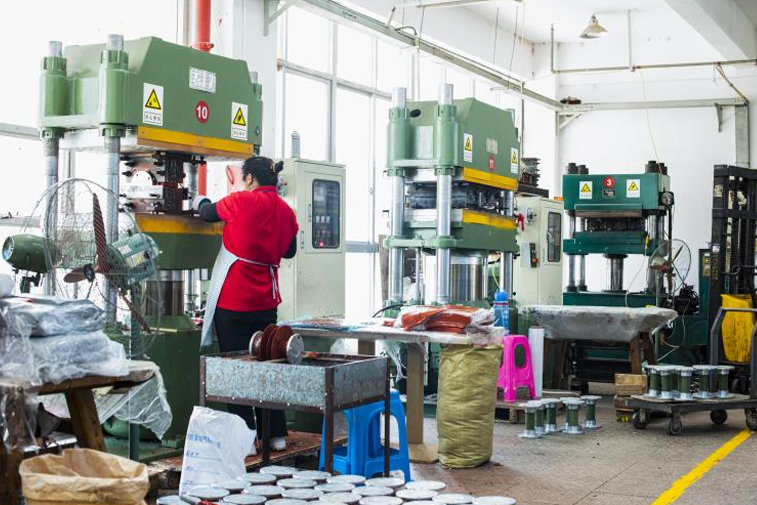
Molding: The most common method is Injection Molding or Compression Molding. The mixed compound is injected/placed into a heated mold cavity under high pressure. This process vulcanizes (cures) the rubber, forming the sheds with high dimensional accuracy and excellent electrical properties.
Adhesion: The molded silicone rubber sheds are permanently bonded to the core fibreglass rod (or metal core) using a high-strength adhesive in a controlled process.
Metal Component Fabrication:
Components like the support rod, hinges, and terminals are typically fabricated from steel or aluminum alloys via processes like casting, forging, or machining.
Surface Treatment: Critical for corrosion resistance. The steel support rod undergoes Hot-Dip Galvanization, coating it with a thick, durable layer of zinc.
Assembly and Testing: All components are assembled in a controlled environment. The final product undergoes rigorous testing, including dielectric withstand tests, mechanical load tests, and operational tests of the drop-out mechanism, to ensure compliance with international standards (e.g., IEC, ANSI).


Application Scenarios:
This 36kV drop-out fuse is deployed in various scenarios within public and industrial power distribution systems:
Overhead Line Protection: Used as the primary overcurrent and short-circuit protection for pole-mounted distribution transformers (e.g., 36kV/400V), safeguarding the transformer from damage due to internal faults or network anomalies.
Line Sectionalizing: Installed along overhead lines to isolate faulty sections. When a fault occurs downstream, only the fuse protecting that section operates, minimizing outage times for customers on healthy sections of the line.
Capacitor Bank Protection: Used to protect and switch pole-mounted capacitor banks used for power factor correction in the grid.
Ideal for Harsh Environments: The 1080mm creepage distance and silicone rubber insulation make this fuse particularly suitable for areas with:
Industrial Pollution: Chemical smoke, dust.
Coastal Salinity: Salt-laden air and fog.
High Humidity: Regions with frequent rain or high moisture levels.


Company Strength:
 |  |
 |  |
 |  |  |
 |  |  |


